Continuous strand of material often made of Nylon. They are affordable and versatile but tend to be weaker and prone to line memory when compared to other kinds.
Numerous fishing lines are available in today’s market, but what determines their quality? In this application note, we explore the potential differences between high, medium, and low-quality monofilament fishing lines.
Gel Permeation Chromatography (GPC) and Differential Scanning Calorimetry (DSC) were used to measure the molecular size and thermal properties of the polymers comprising the three lines
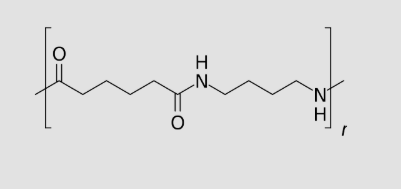
NYLON 6,6
GPC provides valuable information such as absolute molecular weight and dispersity, while DSC provides the melting temperature (T) and glass transition temperature (T) of the samples.
GPC & DSC
Analysis Data & Results
GPC & DSC
Analysis Data & Results
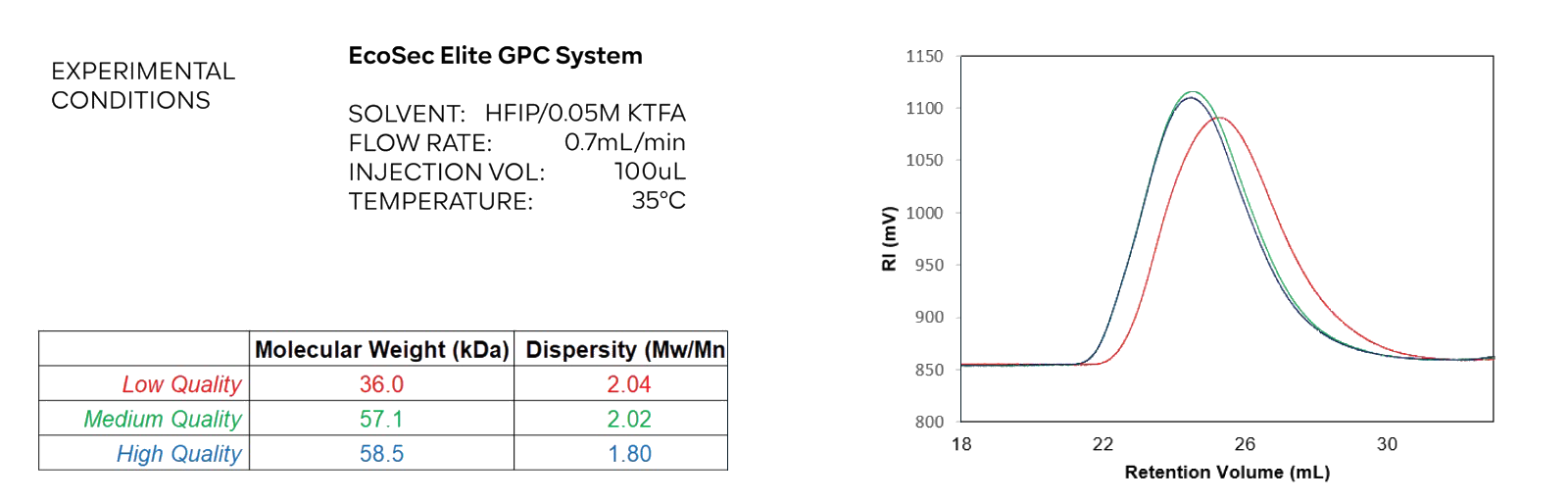
Figure 1. GPC Chromatograms
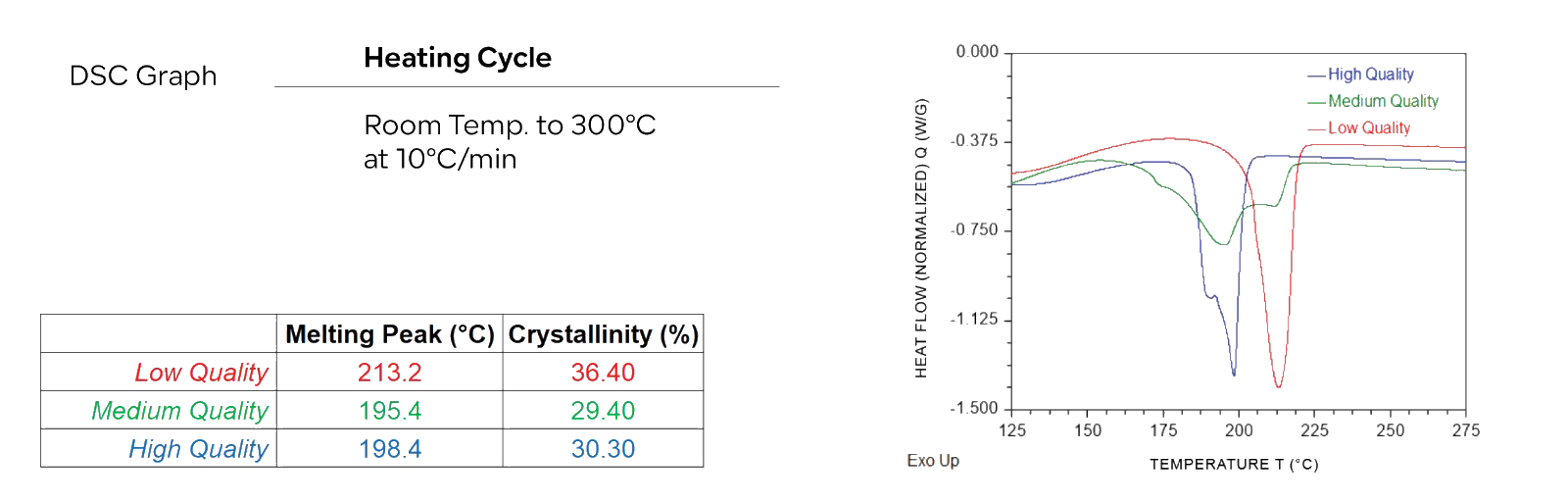
Figure 2. DSC Graph
From the results, it is immediately clear that the low-quality fishing line has a
substantially lower molecular weight than the other two lines (Figure 1). However, the
high and medium-quality fishing lines have a very similar molecular weight and
distribution profile, suggesting that they are the exact same polymer.
How could these
be different?
The DSC traces (Figure 2) between the high and medium-quality fishing lines answers this question. Despite being made of the same polymer, the high and medium-quality fishing lines have different crystallinities and thermal properties. This suggests that the manufacturing process of these two lines is the fundamental factor determining their overall quality.
Let’s Connect!
Get expert analysis and tailored solutions for your research needs.